In January 2017, it became
big news around the world, at least in comparison with other literary
news, that Bram Stoker's "lost" version of
Dracula had been discovered in Iceland, where it had lain forgotten for over 100 years. It was now published in English:
Powers of Darkness: The Lost Version of Dracula. This was an Icelandic translation of
Dracula, originally published in the magazine
Fjallkonan from January 13, 1900 to March 29, 1901, under the title
Makt myrkranna
("Powers of Darkness" in English). It was then published in book form
in 1901. The Icelandic translator was said to be the author and
publicist Jóhann Valdimar Ásmundsson (1852-1902). However, this was a
drastically different version of the 1897 classic edition of
Dracula.
It was the Dutch art historian and Dracula researcher Hans Corneel de
Roos who made the discovery. Together with the internationally renowned
experts Dacre Stoker (related to Bram) and John Edgar Browning, he
compiled the English edition. De Roos, Browning and Dacre Stoker found
that
Makt myrkranna showed obvious signs of having been written
in collaboration with Bram Stoker himself, or had been adapted from an
early draft by Stoker of the classic vampire novel. David J. Skal also
advocated this in his great biography of Stoker,
Something in the Blood (2016).
Makt myrkranna is almost half the length of the 1897
Dracula,
although the opening section with Harker's visit and captivity in
Dracula's castle is significantly longer than the corresponding section
in the 1897 version. The rest consists of little more than an abstract
of the plot, in large parts written in a sketchy manner. On the other
hand, it contains several of the ingredients that Stoker planned to use
in his novel, but which were then removed in the final version. The
discovery of this "lost" version led to detailed speculations: How could
a draft of
Dracula have ended up in Iceland, and who was the
intermediary link between Stoker or his draft of the novel, and the
editor Valdimar Ásmundsson?
As soon as I heard of the English edition, I remembered that the first Swedish translation of
Dracula had the same title in my native language:
Mörkrets makter.
When I looked it up in the online database at the National Library of
Sweden, it appeared that it was published as a serial in the newspapers
Dagen and
Aftonbladets Halfvecko-Upplaga, beginning in the summer and autumn of 1899 – the year
before
the Icelandic edition began to be published. Even this was remarkable
enough. I gave my colleague Jan Reimer the duty to order the edition and
send me copies of the pages, because I live in Bangkok.
It was a jackpot.
Mörkrets makter is far more than just the original text of Ásmundsson's translation. The version published in
Dagen is a full-scale novel without abridgements and sketchy parts – and almost twice as long as the 1897
Dracula! It consists of 1,625,800 characters including spaces, compared to
Dracula's
830,000 characters. Here are also several scenes and characters that
are not even mentioned in the Icelandic edition, and even less in the
classic version.
The novel was serialized in the newspaper
Dagen ("The Day") from June 10, 1899 to February 7, 1900, as "Powers of Darkness: Novel by Bram Stoker: Swedish Adaptation for
Dagen by A–e." Simultaneously, it was published in
Aftonbladets Halfvecko-Upplaga (a special edition of the tabloid
Aftonbladet, published twice a week in the provinces) from August 16, 1899 to March 31, 1900.
Aftonbladet with its half-week edition and
Dagen had the same editor-in-chief, Harald Sohlman, and partly the same editorial staff.
The texts are identical until the end of the first section, when Harker
decides to escape from Draculitz's castle using a sheet as a rope. Then
in
Aftonbladet, the abridged and sketchy style begins, which later appears in
Makt myrkranna. However, the Icelandic version has been abridged even further. For example,
Aftonbladet's version still has Renfield as an important minor character, while he is completely removed in
Makt myrkranna.
It is a bit ironic. So much academic effort and research have been
wasted on an Icelandic text, which is only a pale abridgement of an
already abridged Swedish version, based on an original text published in
the newspaper
Dagen around the turn of the century 1900. It
would not have been very hard to find the Swedish original text, if they
had only paid online visits to more national libraries in Scandinavia
and searched their databases. When the English-language newspaper
Iceland Monitor
wrote about the discovery of the Swedish version on March 6, 2017,
Professor Guðni Elísson explained that literary scholars in Iceland had
long suspected that
Makt myrkranna is just a translation from another Scandinavian language, and not an Icelandic original text – the idea already existed.
However, there is no reason to be mean. After all, it is impossible to
deny that Hans Corneel de Roos and his team were on the right track –
and that the track is both fascinating and invaluable for the research
into the history and background of
Dracula.
The version in
Aftonbladets Halfvecko-Upplaga was never reprinted in Sweden. The full version in
Dagen was republished a second and last time in
Tip-Top
No. 40, 1916 to No. 4, 1918, a cheap weekly magazine for pleasure
reading. There it was presented as "Novel by Bram Stoker. Swedish
Adaptation for
Tip-Top by A–e". But with the exception of details
such as removed dashes and a few new word choices, as well as a few
deleted sentences and paragraphs, the text is identical to the text in
Dagen.
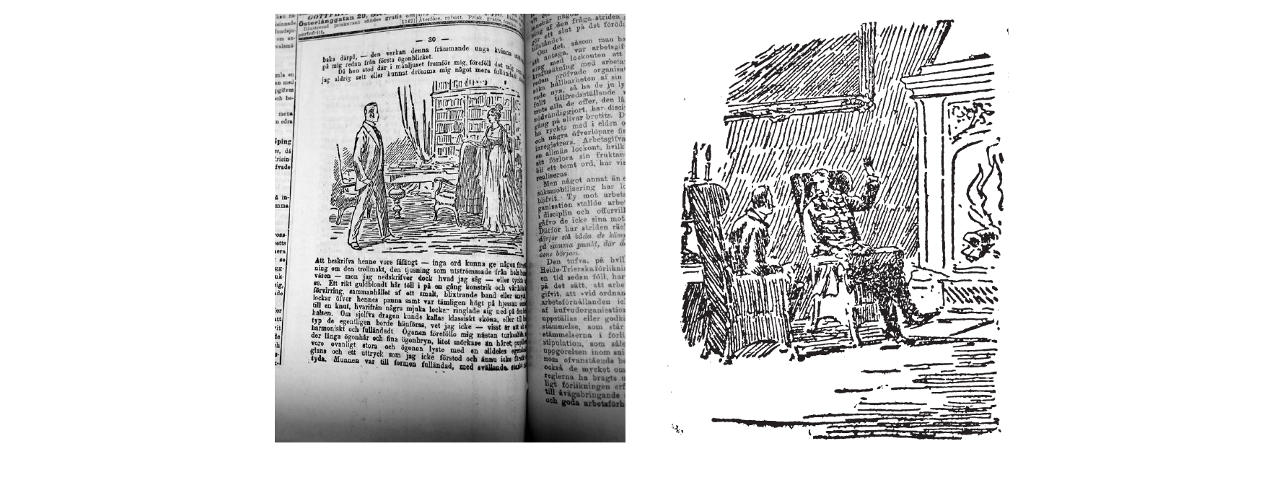
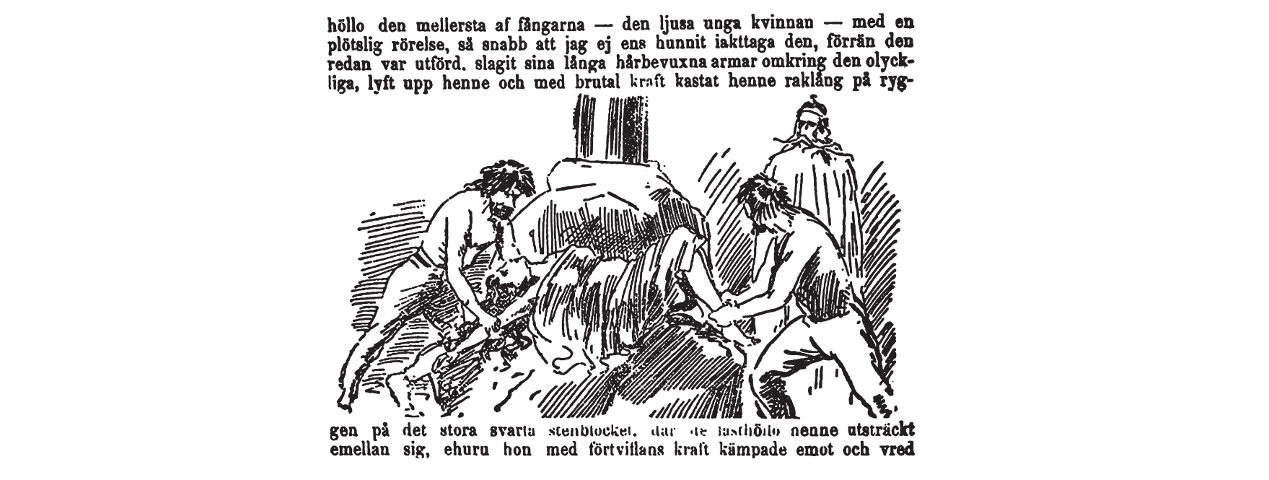
In
Dagen and
Aftonbladets Halfvecko-Upplaga, the novel was
provided with unsigned illustrations. Usually they only show people who
talk to each other and are often not very well-made, but some of the
more interesting examples can be found in this article.
The Swedish small press company Aleph Bokförlag published the full text of
Mörkrets makter
in October 2017 with a preface by John Edgar Browning. And the opinion
remains: "... among the most important discoveries in Dracula's long
history," as Browning writes.
POWERS OF DARKNESS
Mörkrets makter was not entirely unknown in Sweden, as noted in Sam J. Lundwall's standard reference work
Bibliografi över science fiction och fantasy
("Bibliography of Science Fiction and Fantasy," which contains only
Swedish titles). Obviously, however, no literary scholar has noticed how
drastically this version differs from the
Dracula of 1897, and
even less has understood the importance of it. Here, it is not only the
vampire race Dracula wants to spread across the world, he is also
conspiring with politicians and other men of power around the world to
introduce a new world order based on a kind of racial biology and
outright fascist ideas about the natural right to rule inherited by "the
strong" individuals. Count Dracula – or Draculitz, as he is called here
– views the vampire race as the next step in the evolution of humanity,
a new "master race" as Hitler soon was to call it.
Mörkrets makter
can in parts be read as a satire of – and a warning for – the Social
Darwinist theories that flourished at the turn of the century 1900. In a
fascinating dark way, the novel foretells the disasters which Nazism
and Fascism would bring into the world in the 1930s and 1940s.
Toward the end, the novel plays strongly on the
fin de siècle
pessimism of the 1890s and the troubled state of the Western world.
Numerous tensions in national and international politics laid the
foundation for World War I and led indirectly to World War II. Dr.
Seward reflects on this when he is reading a tabloid paper:
By
the way, the telegram section of the newspaper announces several
strange news – lunatic behavior and deadly riots, organized by
anti-Semites, in both Russia and Galicia as well as southern France –
plundered stores, slain people – general insecurity of life and property
– and the most fabulous tall tales about "ritual murders," abducted
children and other unspeakable crimes, all of which is ascribed in
earnestness to the poor Jews, while influential newspapers are
instigating an all-encompassing extermination war against the
"Israelites." You would think this is in the midst of the Dark Ages!
[...] Now, once again, it seems that a so-called "Orlean" conspiracy is
tracked down – while at the same time the free Republicans in France are
celebrating with exaltation the exponent of slavery and despotism in
the East [...] It is a strange time in which we live, that is sure and
true. – – – Sometimes it seems to me as if all the insane fantasies, all
the crazy ideas, the whole world of crazed and scattered notions, into
which I, as a madhouse doctor, for years have been forced to enter in
the care of my poor patients, now begin to take shape and form and gain
practice in the course of the world's major events and tendency.
The "so-called 'Orlean' conspiracy" refers to more or less well-founded
rumors of a planned military coup against France, which in 1898-99
surrounded the pretender to the throne of France: Louis Philippe Robert,
Duc d’Orléans (1869-1926). A detail like this shows that at least parts
of the adaptation was done after
Dracula was published in 1897.
Mörkrets makter also satirizes the zeitgeist with its craze for
occultism and newly constructed religions, where both the Hermetic Order
of the Golden Dawn and Madame Blavatsky's Theosophy were of
significance for the upper classes in England. Deepest below the castle,
chiseled out of the cliff itself, are cavities where Count Draculitz as
a high priest practices a disgusting pagan religion with human
sacrifices, worshiped by beastly degenerated cave people; a religion
that he now plans to spread across the world together with his other
beliefs.
BRAM STOKER AND THE DRACULA OF THE DAY
During his lifetime, the Irishman Abraham "Bram" Stoker (1847-1912) was
known as the assistant and constant companion of the famous actor Sir
Henry Irving. He also served as the head of the Lyceum Theatre in London
with its grand building, in which Irving performed when he was not on
tour. Stoker's writing was a spare-time occupation for him during this
time, but he was forced into the role of professional writer after 1905
when Irving died and his employment at the Lyceum Theatre ended.
Stoker's finances suffered and periodically he needed medical care
because of overwork. Towards the end of his life he is believed to have
suffered several strokes. The cause of his death is obscure, but David
J. Skal argues strongly for the controversial opinion that Stoker died
from syphilis infecting the nervous system (and thus also caused what
has been interpreted as blood clots in the brain).
Dracula became a success for critics as well as the audience when
it was published by Archibald Constable & Co., Westminster,
although it would take a long time before it achieved the monumental
classical status it has today. Stoker had published theatre reviews,
short stories and four novels between 1890 and ’95, but only a few of
the stories had a horror motive. After the vampire orgy with the
Transylvanian Count, he returned to the horror genre with
The Jewel of Seven Stars (1903) and the Gothic
The Man (1905). His last horror novels are reminiscent of
Dracula with a woman believed to be a vampire in
The Lady of the Shroud (1909), and with a vampire-like monster in
The Lair of the White Worm (1911), in which a seductive and murderous woman is actually a giant worm that lives hidden in the caves under a castle.
As early as January 1 to March 29, 1898, a Hungarian translation of
Dracula was published in the newspaper
Budapesti Hírlap, based directly upon the text of the 1897 novel. The following year,
Dracula was published as a serial in the American newspaper
Charlotte Daily Observer,
starting on July 16, 1899, and completed on December 10, the same year.
This text also matches the original novel and is available online in
scanned form.
Prior to this, beginning on May 7, 1899, the daily paper
Inter Ocean in Chicago published the novel under the title
The Strange Story of Dracula.
When Hans de Roos discovered this American serial publication earlier
this year (2017), he overly enthusiastic went public and argued that it
was the original of the Swedish
Mörkrets makter, a conclusion
that he based solely on one single detail: that Lucy Westenra in a
series of advertisements for the publication had the name misprinted as
Lucy Western. However, this is a false track that he has abandoned, and
copies of the serial published by him, as well as a description of the
plot in an advertisement, show that
Inter Ocean simply published the text of
Dracula
(1897) once again. De Roos is a natural force when it comes to
ambitious excavations in databases and archives, but his enthusiasm
sometimes gets the best of him.
These are the known instances of
Dracula in print until the time of the original publication of
Mörkrets makter in the newspaper
Dagen. It is not out of the question that
Mörkrets makter is a translation or adaptation of a similar version published in another country, but there is nothing to suggest this.
Mörkrets makter remains a unique version of
Dracula.
HARKER AND THE BLONDE FEMME FATALE
One of the most interesting differences between
Mörkrets makter and
Dracula
is the presence of a blonde and blue-eyed vampire woman who is
constantly seeking to seduce Harker in the castle of Draculitz and
trying to lure him into corruption. In the text of 1897, there are three
women, two dark and one blonde, who in one scene show erotic blood lust
for Harker. Nevertheless, they play a rather insignificant role in the
novel, unlike Harker's blonde man-eater in
Mörkrets makter. This is steaming eroticism:
Just
then, two large, flaming summer lightning flashes, almost immediately
following each other, illuminated everything with a bright electric
light. In this glow she was suddenly in front of me –, quite
close – – – dazzling – like a white flame, with the same tempting and
enigmatic smile as when I first saw her eyes of blue fire, burning into
my brain and causing my strength and will to melt like wax. I saw her
thusly for a few seconds only, slender and yet voluptuous against the
dim light in the room – then it was dark again [...]
Once again the quiet, fiery glow blazed, ghostly and otherworldly – it
showed me her lovely face, close to my own, leaning over me, her eyes
holding my eyes; the longing, voluptuous red lips were half-open, the
jewel upon her white bare bosom, sparkling; I saw how she fell to her
knees, next to the bench on which I was lying; in the next moment it was
dark again, and in a dizzying half-conscious state, I felt as if I were
sinking into an abyss [...] – – over my face I felt her breath, warm
and intoxicating – – felt a pair of swollen lips pressed against my neck
in a long, burning kiss that made my very essence tremble in the thrill
of desire and anguish – and in an unbridled trance I enclosed the
beautiful apparition in my arms – –
Compare this with the corresponding scene in
Dracula, where the
blonde one of the women approaches Harker for the "vampire kiss." The
scene is classic for its "sexiness", but appears lame in comparison.
DRACULA'S MYSTICAL GUEST
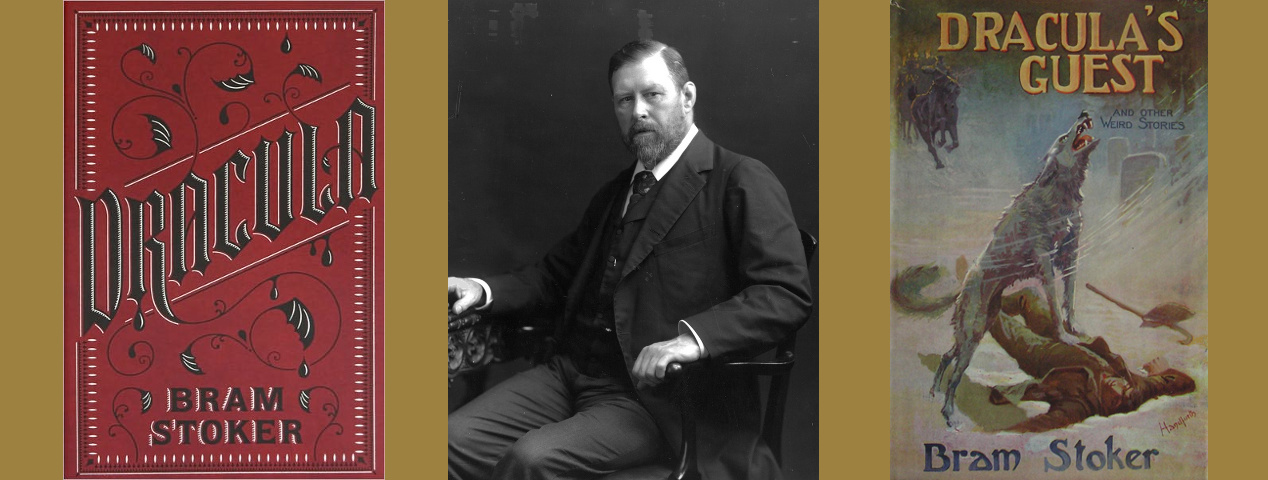
Bram Stoker's short story "Dracula's Guest" throws an interesting light
on this blonde vampire woman. The story was published in 1914 in the
collection
Dracula's Guest and Other Weird Stories edited by Bram's widow Florence. In the preface, she claimed that it was an unpublished part of
Dracula that had been deleted because the novel was too long. For a long time, the text puzzled
Dracula researchers, because it simply does not fit into the novel.
The story takes place outside of Munich during Walpurgis Night, on April 30, while
Dracula
begins with Jonathan Harker arriving at Bistritz from Munich a few days
later, May 3. "Dracula's Guest" was therefore assumed to be a deleted
first chapter. But the events in this short story have nothing to do
with the plot of the novel and the style is completely different from
Jonathan Harker's other notes. Furthermore, the ending, with its
allusion on Dracula, seems to be superimposed.
The Englishman in the story (Harker, but the name is not mentioned) goes
out into the wilderness outside of Munich to visit a legendary deserted
city. However, he is surprised by a violent snowstorm and finds shelter
in a tomb. There lies a Countess Dolingen of Gratz, who committed
suicide in 1801. Inside the bronze door, in the light of a flash, Harker
sees a beautiful woman seemingly sleeping on a bier. The next lightning
bolt eradicates the tomb at the same moment as the woman stands up.
Harker is then found by some soldiers, semi-unconscious, at the ruin,
where he was watched and kept warm by a great wolf which was licking his
neck. As events evolve, it becomes obvious that it was Count Dracula
who protected his future guest against the undead Countess by creating
the rage of the elements, and in the form of the wolf kept him alive in
the cold of the winter night.
Today, we know that "Dracula's Guest" really was a deleted part of a
previous version of Dracula.; this mainly because of an unexpected find
in the early 1980s in a barn in northwestern Pennsylvania, USA: Stoker's
typescript for the vampire novel, very close to the final version of
1897. The typescript had belonged to Thomas Corwin Donaldson (1843-98), a
Philadelphia lawyer, a close friend of Bram Stoker.
"Dracula's Guest" cannot be found in this typescript, either – but there
are sentences and parts which overtly mention the fatal adventure
during Walpurgis Night. These are fragments that were deleted before the
final publication and apparently remained in the typescript by mistake.
For example, Harker mentions this adventure in a discussion with Count
Dracula, and here is a sentence in which Harker complains that his
throat still aches after a gray wolf has licked it with its sharp
tongue.
The episode is also suggested in Stoker's work notes for
Dracula: "Adventure snow storm and wolf." [EM p. 40.]
[1] In fact, the notes show that Stoker had provided
Dracula
with an elaborated prehistory before Harker arrives in Bistritz, which
was then rejected. In Munich, according to the notes, Harker stays at
the Quatre Saisons, the same inn he stays at in "Dracula's Guest," but
which is not mentioned in Dracula; and in the town he experiences
strange events in a "dead house". During the trip from London, Harker is
escorted by letters from Dracula, similar to the one at the end of
"Dracula's Guest". [EM p. 10 & 40.]
Stoker's typescript reveals something further: The Countess in the tomb
is identical to the blonde one of the three vampire women in Dracula's
castle. In the scene where the women approach Harker and the blonde
vampire tries to "kiss" him, the following passage can be found in the
typescript, also deleted in the final version: "I was looking at the
fair woman and it suddenly dawned on me that she was the woman – or her
image – that I had seen in the tomb of Walpurgis Night..."
The description of this blonde vampire in
Dracula reads: "The
other was fair, as fair as can be, with great wavy masses of golden hair
and eyes like pale sapphires." – This is a brief description, but it is
obvious that it conforms with the blonde vampire woman who besets
Harker lasciviously in
Mörkrets makter. Some reviewers and commentators of
Makt myrkranna/
Powers of Darkness
claim that she is drawn like a typical blonde, Scandinavian ideal
woman, and that this is an example of an addition done by Ásmundsson on
his own. However, the description is already to be found in
Dracula (1897).
Mörkrets makter also lacks an episode like "Dracula's Guest", but
we get a rich background for the blonde vampire. She turns out to be a
Countess "from the beginning of the century" in accordance with the dead
countess in "Dracula's Guest"; she is not even mentioned as a Countess
in
Dracula. How she died, however, is left to the reader's imagination – but it is very possible that she was driven to take her own life.
The language of "Dracula's Guest" differs significantly from the
concentrated and unvarnished prose that Jonathan Harker uses in
Dracula (1897); on the other hand, it is in line with the language of
Mörkrets makter.
In addition to this it has to be mentioned that Stoker, in his work
notes from 1892, really planned to use only one vampire woman and not
three in Dracula's castle [EM p. 12] – a detail that was strangely
overlooked in the English translation of
Makt myrkranna. In the
very earliest notes, several women appear in Dracula's castle without
their number being specified. For the final version, Stoker decided on
three vampire women, the blonde still being given the most prominent
role.
A LEAD FROM H.P. LOVECRAFT
It is quite clear from the circumstances surrounding "Dracula's Guest", that Stoker wrote earlier versions of
Dracula.
But there is a more direct confirmation of this from an unexpected
source, none other than the classic American horror writer Howard
Phillips Lovecraft (1890-1937).
In a letter to Frank Belknap Long, October 7, 1923, he declared: "Mrs.
Miniter saw 'Dracula' in manuscript about thirty years ago. It was
incredibly slovenly. She considered the job of revision, but charged too
much for Stoker." (
Selected Letters vol. 1.)
Mrs Miniter in the quote is Lovecraft's good friend, the writer and
journalist Edith Dowe Miniter (1867-1934). They found common ground as
friends in their mutual interest in New England's local history and
their commitment to the United Amateur Press Association, an
organization for amateur magazines and amateur journalism. They
socialized from 1920 until her death, and during brief visits Lovecraft
stayed at her home.
In a letter to Donald Wandrei, January 29, 1927, Lovecraft repeats
almost the same information about Stoker's manuscript: "... it is
curious to note that one of our circle of amateur journalists – an old
lady named Mrs. Miniter – had a chance to revise the 'Dracula' MS.
(which was a fiendish mess!) before its publication, but turned it down
because Stoker refused to pay the price which the difficulty of the work
impelled her to charge.” (
The Lovecraft Letters vol. 1.)
As well as in letters to R.H. Barlow Dec. 10, 1932: "I know an old lady
who almost had the job of revising 'Dracula' back in the early 1890’s –
she saw the original MS., & says it was a fearful mess. Finally
someone else (Stoker thought her price for the work was too high)
whipped it into such shape as it now possesses." (
O Fortunate Floridian.)
In another letter to Barlow in September 1933, Lovecaft added that Mrs.
Miniter did not have any personal contact with Stoker: "She never was in
direct contact with Stoker, a representative of his having
brought the MS. & later taken it away when no terms could be
reached." (Same source.)
Finally, in a memoir of the recently deceased Mrs. Miniter, written in
1934 but published in 1938, Lovecraft provides additional information as
well as a new part of the reason why Mrs. Miniter did not accept the
assignment: "Notwithstanding her saturation with the spectral lore of
the countryside, Mrs. Miniter did not care for stories of a macabre or
supernatural cast; regarding them as hopelessly extravagant and
unrepresentative of life. Perhaps that is one reason why, in the early
Boston days, she had declined a chance to revise a manuscript of this
sort which later met with much fame – the vampire novel Dracula, whose
author was then touring America as manager for Sir Henry Irving."
(According to the quotation in David J. Skals'
Something in the Blood.)
This has been claimed to show that Lovecraft gave conflicting
information about the incident, but this claim is unfounded; Lovecraft
is clear that he is speculating ("Perhaps that is one reason..."), and
Miniter did not accept a lower sum for an assignment which did not
interest her. That Stoker
also rejected her counteroffer does not implicate any contradiction, of course.
If Lovecraft's details are correct – it was, after all, 30 years later
that he was told this by Edith Miniter – she was contacted about the job
when Sir Henry Irving and his ensemble were on tour in the United
States, backed by Bram Stoker. David J. Skal, in his Stoker biography,
explains that the tour began in 1893 and came to Boston in January 1894,
where Edith Miniter worked for the
Boston Home Journal, a weekly magazine for literature and art. Irving's productions were reviewed in the
Boston Home Journal
– but in a remarkably scathing way; in fact, it was among the most
negative reviews the Lyceum received during its tour of the US. Bram
Stoker was the press contact during the tour, and Skal assumes that he
contacted the editorial board for some diplomatic talk, as was his wont.
With this, Skal suggests the possibility of a contact between Stoker
and Miniter although it was not in the best circumstances; but it is
conceivable that Stoker came to terms with at least Edith Miniter on the
editorial staff. It is also conceivable that the contact between them
was brought about completely independent of the
Boston Home Journal – after all, they moved in the artistic and literary circles of Boston at the same time.
MÖRKRETS MAKTER IN STOKER'S NOTES
In Eighteen-Bisang and Miller's
Bram Stoker's Notes for Dracula, the section "Limitations of the Notes," the editors explain that Stoker may well have written more notes for
Dracula
than those present. The editors add: "Almost half the events in the
novel are not mentioned in the Notes. Most of the interactions between
human beings and vampires from chapters 16 to 27 [in
Dracula] are
missing." They also make clear that it is "highly unlikely that Stoker
moved directly from the Notes to the typescript. He probably bridged the
gap between them with one or more lost drafts of the novel."
One of the striking correspondences between Stoker's work notes and
Mörkrets makter, but not with the
Dracula
of 1897, has already been mentioned: The presence of a lone vampire
woman who makes advances on Harker in the Count's castle. Here follows a
number of other similarities that are missing in Stoker's finished
novel:
In Stoker's notes, Lucy finds a "mysterious brooch" on the beach outside
Whitby, probably meant to come from the wrecked ship that brought
Dracula to England. This piece of jewelry then plays a mysterious role
when Lucy is sleepwalking in Whitby's cemetery and gets attacked. [EM p.
18, 19 and 34.] In
Mörkrets makter, she falls under the
influence of a similar mystical Piece jewelry when meeting the gypsies
who have camped outside Whitby, and who are in collusion with Draculitz.
The seductive blonde woman in Draculitz's castle wears the same kind of
jewelry; and Harker receives a gift from the Count, a ring with a
suggestively gleaming ruby Similar to the other pieces of jewelry. They
have some kind of hypnotic impact on Harker and Lucy.
In the notes, the Count has a deaf-mute servant [EM p. 1 & 7], while
the Count himself takes care of all the tasks of the household in
Dracula. The notes indicate that this woman is the Count's servant in England, but in
Mörkrets makter
she is only present in Count Draculitz's castle. Another servant of
Dracula is mentioned in Stoker's notes, a "silent man", possibly
originally the coachman who brings Harker to the castle. In
Dracula, the Count himself plays the role of the coachman, as well as in
Mörkrets makter.
In the notes there is a detective Cotford. [EM p. 1 & 7.] This detective has a significant role in
mörkrets makter under the name Edward Tellet, subsequently assisted by another colleague named Barrington Jones.
In repeated notes Stoker mentions a blood-colored room: "Secret room –
colored like blood"; "Count's house searched º blood red room"; "the
blood room"; "Searching the Count's house – the blood red room"; "Secret
search Count's house – blood red room". [EM p. 7, 8, 15, 27 & 34.]
In
Mörkrets makter, this blood-colored room turns out to be the
vampire Countess Ida de Gonobitz-Vàrkony's most intimate and dangerous
chamber, where she lives on Draculitz's estate Carfax. Dr. Seward
describes it thus:
I
was in a bedroom, decorated with great luxury as well as illuminated by
a hanging lamp with a blood red screen. Everything in the room was of
the same color, in my opinion not very suitable for the calm, soothing
atmosphere you would like to find in a bedroom – a strong flaming
redness, which penetrated and filled the whole atmosphere. [...] Roofs
and walls were covered with ruby red velvet; two of the large walls were
almost entirely covered with immense mirrors, framed with red plush –
the carpet had the same red color, and both windows and doors were
completely covered in red draperies, while the bed itself was so
dressed, draped and mattressed with silk and velvet in this deep,
brilliant color, that it resembled a case for some expensive jewelry,
more than an ordinary resting place.
Perhaps this room in deep red was originally meant to be Dracula's orgy
chamber, but obviously it is better suited for a woman. In
Mörkrets makter,
Draculitz has a similar room in another building where he seduces his
victims, although arranged in a much more masculine fashion.
In Stoker's notes, Dr. Seward – the administrator of the insane asylum
in the neighborhood of Carfax – is described as "a mad doctor". [EM p. 1
& 5.] In
Dracula, he has no problems with his own mental health, but in
Mörkrets makter
it is a significant plot point that he understands he is on the verge
of insanity, and at the end also becomes insane. His mind is suffering
from the sorrow of Lucy's death and the fabulous experiences he is
forced to undergo at Carfax.
Were Dr. Seward and Renfield originally one and the same person, whom
Stoker then chose to divide into two characters? It would be logical if a
mad doctor developed the theories of immortality and the flow of
life-force in the development stages of the species, which are now
thought out by the scientifically ignorant Renfield. However, the insane
doctor and his patient are already mentioned on the very earliest pages
of notes:
Mad Doctor – Loves Girl
Mad patient – theory of perpetual life
HOW MUCH BY STOKER?
All the details listed here are found in Stoker's notes from 1890 to
1892, according to their own dates and the order in which
Eighteen-Bisang and Miller placed them. After 1892, the dating of the
notes is very unclear, but the notions approach the final version of
Dracula. The draft which was the basis of
Mörkrets makter seems to have been written at this stage or soon afterwards.
However,
Mörkrets makter cannot possibly be a straight
translation of this early draft. Jonathan Harker, Mina Murray, Lucy
Westenra and Dracula are named with their final names already in these
early notes 1890-92, but have been changed to Thomas Harker, Vilma
Murray, Lucy Western and Count Draculitz respectively in the Swedish
adaptation. In
Mörkrets makter there are allusions to world events that occurred after
Dracula's
original edition in 1897, with examples such as the "Orlean conspiracy"
1898-99. In the section with the human sacrifices under Dracula's
castle, the flame-lit scene is compared with the flickering pictures of
the cinematograph. The cinematograph (the first film projector) was not
patented until 1895 and began to be used commercially only in 1896.
The big question is how much has been adapted or elaborated by "A–e".
Stoker's early draft must have contained the pre-history before Harker
arrives at Bistritz. The fact that it was deleted suggests that the
editor was inspired by
Dracula 1897 during the work. The whole
subplot about Draculitz's political conspiracy of a fascist nature can
be a Swedish addition based on the Social Darwinistic hints already in
Dracula,
[2] which would explain the hybrid-like
impression given by the vampire theme in combination with political
thriller and satire. The theme of
fin de siècle – the pessimism
and decadence at the end of the 19th century – in the last quarter of
the novel seems to have been added to make the novel contemporary; this
closing part was published in the newspaper
Dagen from December 1899 until early February 1900.
However, there is a strange hint to immortality and high politics also
in Stoker's early notes: "Immortaliable – Gladstone". [EM p. 6.] William
Gladstone was the Prime Minister of the UK and a good friend of with
Sir Henry Irving. And after all, the style of the language is remarkably
consistent throughout the novel. The text is also in no small amount
interspersed with translation mistakes in the form of Anglicisms.
At this stage, it is simply not possible to know how much of the text
reflects Stoker's original draft, and how much is deleted, added and
reworked by "A–e".
BRAM STOKER AND SWEDEN
Dracula had already attracted attention abroad. Why did not the editorial office behind
Dagen and
Aftonbladets Halfvecko-Upplaga
just translate the already released novel straight off? It would both
be cheaper – Sweden had not yet entered the Bern Convention at this
time, wherefore pirated translations of foreign writers were par for the
course – and, more importantly, significantly cheaper than paying the
signature A–e for a "Swedish adaptation" twice as long as the original
novel. At least A–e was paid for this gigantic work, one can safely
assume. This was not a simple pirate edition among others.
The editorial staff of
Dagen and
Aftonbladets Halfvecko-Upplaga
certainly expected that they, with Stoker's draft as a basis, had a
guaranteed literary success, a future alternative classic to
Dracula 1897.
However, the hope of success was frustrated. Only the Icelandic translation of
Aftonbladet's shortened text was realized, and the two Swedish versions were never printed in any separate book editions.
[3] The novel was published only one more time 16 years later in the cheap weekly magazine
Tip-Top – and then fell into oblivion. The circumstance that the serial in
Aftonbladets Halfvecko-Upplaga
was shortened radically after the initial part had been printed, can
also be interpreted as a result of the success that never happened; they
wanted to leave room for new serials as soon as possible, which
hopefully would appeal better to the audience.
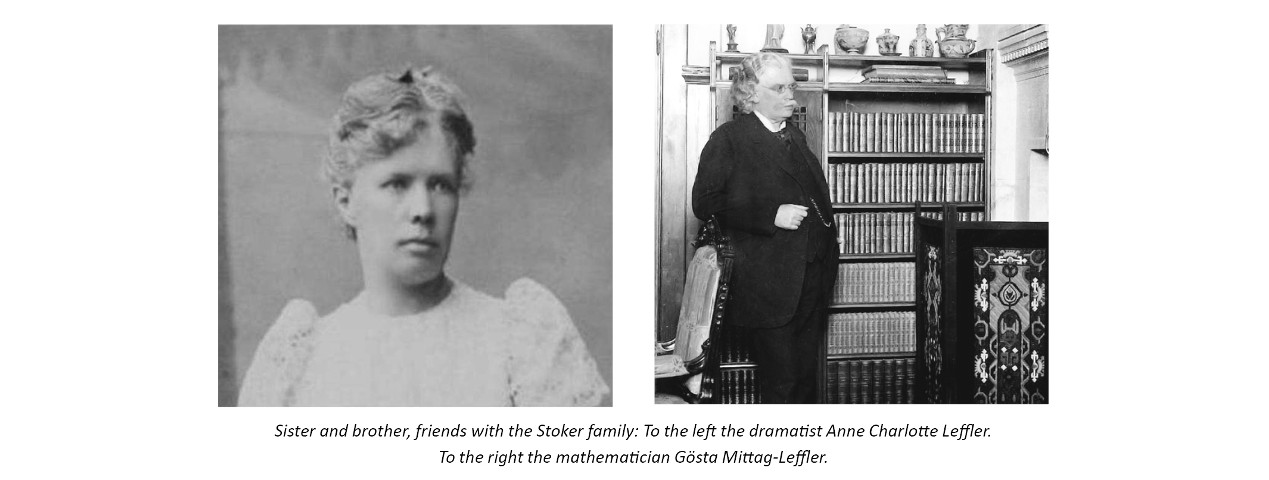
How did Bram Stoker's draft end up in Sweden? Here we come to the author
and playwright Anne Charlotte Leffler (1849-92) and her brother, a
mathematician and man of art and culture, Gösta (Gustaf) Mittag-Leffler
(1846-1927).
Anne Charlotte Leffler, today rather forgotten, addressed mainly women's
liberation in her drama. She was a highly successful, much-disputed and
controversial writer even internationally during her lifetime; she is
said to have attracted more attention in England than Henrik Ibsen. Her
brother Gösta Mittag-Leffler was, for his part, an internationally
renowned professor of mathematics, member of the Royal Swedish Academy
of Sciences and honorary member of the Royal Society in England. Yet, he
also held a strong interest in culture and literature and was
diligently involved in the literary circles of Stockholm, where he acted
as a debater in cultural and political matters. In 1914, he was
prosecuted and convicted for defamation of the Prime Minister Karl
Staaf; however, the verdict was thrown out by the Supreme Court because
of formal inaccuracies in the prosecution.
In the manuscript collection at the National Library of Sweden, letters
and messages are kept, which show that Anne Charlotte Leffler and Gösta
Mittag-Leffler were good friends with Bram Stoker's siblings, and thus
probably with Bram himself. A letter to Anne Charlote Leffler from Bram
Stoker's brother George Stoker (1854-1920), dated 1887, is preserved, as
well as an undated business card from him to Gösta Mittag-Leffler. In
the National Library there are also 7 letters to Gösta Mittag from
Bram's sister Margaret Dalrymple Stoker (1853-1928), written from around
1874 until 1883. There are also three undated letters of 1875 to Gösta
from a Mathilde Stoker. It is unclear whether this is Bram Stoker's
mother Charlotte Mathilda Blake Stoker (1818-1901) or his sister, the
artist Charlotte Matilda Stoker Petitjean (1846-1920). The
correspondence is commonplace and does not contain anything of
particular interest for a literary scholar; however, it shows that the
contact between the Leffler and Stoker siblings was extensive and
familiar.
But there is more. On the whole, Anne Charlotte Leffler had extensive
contacts also with friends of Bram Stoker; she simply moved in the same
circles. At the National Library there is a letter to her, undated but
written in 1884, from Francisca Elgee Wilde, more famous as Jane Wilde
(1821-96) – Oscar Wilde's colorful mother. In Dublin she ran a literary
salon where young Bram Stoker was a frequent visitor. He started hanging
out with the family and became a dear friend of her son’s. David J.
Skal describes their friendship in detail in
Something in the Blood. Bram Stoker's wife Florence also had a relationship with Oscar Wilde before she abandoned him for Bram.
In one of Anne Charlotte Leffler's letters to Adam Hauch, quoted in her letter and diary collection
En självbiografi (1922), she describes her encounter with Lady Wilde during a stay in London in 1884:
I
have made acquaintances in a lot of literary circles. The other day I
received an invitation to a Lady Wilde, a well-known literary lady, who
is just publishing a book about Scandinavia, in which she mentions me as
one of the leading authors at home, and she necessarily wanted to meet
me, when she was told that I was here. It was the most precious parties I
ever had. Her son, Oscar Wilde, famous poet and leader of the so-called
Aesthetic movement here, usually wears breeches and a Spanish coat, she
never shows herself in daylight, wherefore her room was darkened in the
middle of the day and only illuminated by an artificial red light –
dressed in a light, deep decollated silk dress (on a morning reception)
very painted, the furniture the most motley bric-a-brac, remnants of
their former glory, but broken, which was not meant to be seen in the
dusk – – –.
Lady Wilde as a vampire? The Irish writer lived at this time in misery
in London, after her husband died bankrupt a few years earlier.
Was Oscar Wilde himself present at the gathering? It is possible to read
her letter in that way. In Leffler's diary of May 9 that same year, she
and Oscar Wilde even visited a "hermetic society" in London: "Mystical
drawing-room meeting. Hermetic, theosophical society in evening dress.
Doctor Mrs. Kingsford loveable, beautiful, intelligent, very self-aware,
yellow-red hair, tall and slim, pale face. Oscar Wilde with 'nasty
looks' on limping, pockmarked miss Lord. Two hermetic celebrities
speaking."
Monica Lauritzen's biography
Sanningens vägar: Anne Charlotte Lefflers liv och dikt
(2012) recounts that Leffler was a frequent theater-goer during the
same period in London, most impressed by Sir Henry Irving's version of
Shakespeare's
Much Ado About Nothing, which she must have seen at
the Lyceum Theatre. Unfortunately, Lauritzen does not provide many
concrete details about this event. Was Leffler introduced to the great
actor after the performance? At least it would be bad etiquette if she
did not exchange words at the Lyceum with Bram Stoker, whose brothers
and sisters she had such good contact with. Generally we have to assume
that Leffler socialized with the Stoker siblings during her time in
London, although it is not evident in the letters and diary notes known
to date.
Exactly how it happened when Bram Stoker's draft of
Dracula came to
Aftonbladet's
editorial office in Stockholm, we do not know, but it is a very strong
working hypothesis that Anne Charlotte Leffler and Gösta Mittag-Leffler
have something to do with it. Much more research is needed than has
been possible to do so far.
Anne Charlotte died in October 1892 of appendicitis, but Gösta continued
to be active in the literary circles of Stockholm until his death in
1927.
THE SIGNATURE A–E
Who was the signature "A–e" who undertook to revise Stoker's draft into a
readable novel? Briefly, it is hidden in obscurity and something that
requires more research as well. The signature was a one-off event in
Dagen and
Aftonbladets Halfvecko-Upplaga.
The dash that connects the "A" with the "e" seems to suggest that it is
a masked name, such as Alice or Anne. But of course it is more than
unlikely that Anne Charlotte Leffler was the editor of
Mörkrets makter, not least because she died as early as 1892.
It can also be a shortened nickname. A writer in provincial newspapers,
Algot Agelborg, sometimes used the signature A–e for his nickname
"Agge", but born in 1894, he was only five years old when the serial was
published. Birger Landén (1846-1927), a minor debater on religious
issues, sometimes used the signature A..e. Apparently, he produced no
fiction or translations, and nothing indicates that he had a connection
to
Dagen or
Aftonbladet.
As for the signature A.E. and variants on it, there is no lack of
candidates; for example, the authors Albert Andersson-Edenberg
(1834-1913), Albert Engström (1869-1940) and Daniel Bergman (1869-1932).
All of these had connections to
Aftonbladet. Albert Engström even wrote a Gothic horror novel in the form of
Ränningehus (1920); but much is needed to believe that this legendary humorist, cartoonist and writer was behind the signature A–e.
Faithful to his habit, Hans Corneel de Roos has speculated lively about
who A–e may have been. According to his first proposal in an article in
March 2017, A–e was an abbreviation for "
Aftonbladet's editor" (sic!), in other words,
Aftonbladets and
Dagens editor-in-chief Harald Sohlman. This reasoning can be dismissed because of its own absurdity (the Swedish word for editor is
redaktör). His next proposal, in May 2017, he brought forward as indubitable: that A–e was
Aftonbladet's
co-worker Albert Andersson-Edenberg, based on the fact that he
sometimes signed his articles and translations with A.E. and A.-E. – and
had written an article in
Svenska Familj-Journalen about antique iron-clad doors. In Dracula's castle in
Mörkrets makter
there are also ancient iron-clad doors! But such a detail is exactly
what you can expect in an ancient castle. De Roos claimed that he found
many more similarities between
Mörkrets makter and articles
written by Andersson-Edenberg, but did not give an account of them. If
any of this evidence was stronger than the case of the iron-clad door,
he would probably have mentioned it instead.
It is still too early to point out someone as the identity behind A–e.
All this, including information about the connection between the Leffler
and Stoker siblings, requires careful and thoughtful research before
any truths are established.
You will have to wait and see. Follow this story and how it develops here at
Weird Webzine.
* * *
Rickard Berghorn (born 1972) is the editor of
Weird Webzine
and the Swedish publishing house Aleph Bokförlag. He has written short
stories published in, for example, Sam J. Lundwall's magazine
Jules Verne-Magasinet
and radio plays for Swedish Radio broadcasted nationally. Together with
Annika Johansson, he wrote the first Swedish presentation of the
history of the horror genre,
Mörkrets mästare ("Masters of Darkness", BTJ Förlag 2006).
NOTES
[1] EM stands for Eighteen-Bisang & Miller, the two
scholars who edited Stoker's work notes; the page numbers represent the
order in which EM placed them. See Bram Stoker's Notes for Dracula
(2008). The notes had been studied by a handful of researchers since
the 1970s but were published by Eighteen-Bisang & Miller in 2008.
[2] Mathias F. Clasen analyzes this in depth in his dissertation Darwin and Dracula: Evolutionary Literary Study and Supernatural Horror Fiction (Department of English, Aarhus University 2007).
[3] However, it can be mentioned that the serial was published in book page format in Dagen and Aftonbladet's Halfvecko-Upplaga,
in a way that made it possible to cut out the sheets and hand them over
to a book binder. This was a common way of publishing serials in Sweden
in the 19th century.
REFERENCES
Many thanks to Martin Andersson and Jan Reimer for help with
references. The abovementioned letters etc. from the Stoker siblings and
Jane Wilde can be found in the manuscript department of the National
Library of Sweden, and they mainly belong to the Gösta Mittag-Leffler
Archive. Most of them have not yet been registered in the National
Library's databases but were obtained upon request in February 2017.
Thanks also to Karin Sterky at the National Library for help with this.
• Bygdén, Leonard: Svenskt anonym- och pseudonym-lexikon vol. I (Uppsala: Akademiska Boktryckeriet 1898-1905). On the net <runeberg.org/sveanopse>. Access date 2017-09-28.
• De Roos, Hans Corneel: Next Stop Chicago! Earliest U.S. serialisation known so far discovered. Was it the source for Mörkrets Makter? On the net <vamped.org/wp-content/uploads/2017/05/HansDeRoos_For-Vamped-Org_v12.pdf>. Access date 2017-09-28.
• De Roos, Hans Corneel: The True Source of Makt Myrkranna?
(Children of the Night Dracula Congress. Official Bulletin of the Brașov
Congress Initiative. No 1, March 2017). On the net
<dracongress.jimdo.com/conference-bulletin>. Access date
2017-09-28.
• Eighteen-Bisang, Robert & Miller, Elizabeth: Bram Stoker's Notes for Dracula: A Facsimile Edition (London & Jefferson, NC: McFarland & Company, Inc. 2008. ISBN 9780786 434107).
• "Icelandic version of Dracula, Makt myrkranna, turns out to be Swedish in origin." Article in the Iceland Monitor
6/3 2017. On the net
<icelandmonitor.mbl.is/news/culture_and_living/2017/03/06/icelandic_version_of_dracula_makt_myrkranna_turns_o>.
Access date 2017-09-28.
• Lauritzen, Monica: Sanningens vägar: Anne Charlotte Lefflers liv och verk (Stockholm: Bonniers 2012. ISBN 9789100130275).
• Leffler, Anne Charlotte: En självbiografi: Grundad på dagböcker och brev (ed. Jane Gernandt-Claine & Ingeborg Essén. Stockholm: Bonniers 1922).
• Lovecraft, Howard Phillips: Selected Letters I: 1911-1924 (ed. August Derleth & Donald Wandrei. Sauk City, WI: Arkham House 1965).
• Lovecraft, Howard Phillips: The Lovecraft Letters: Mysteries of Time & Spirit: Letters of H.P. Lovecraft & Donald Wandrei vol. 1 (ed. S.T. Joshi & David E. Schultz. Night Shade Books 2005. ISBN 1892389509).
• Lovecraft, Howard Phillips: O Fortunate Floridian: H.P. Lovecraft's Letters to R.H. Barlow (ed. S.T. Joshi & David E. Schultz. Tampa, FL: University of Tampa Press 2007. ISBN 9781597320344).
• "Orleans, Louis Philippe Robert, Duke of." Article in Encyclopædia Britannica
vol. 20, 1911. On the net
<en.wikisource.org/wiki/1911_Encyclop%C3%A6dia_Britannica/Orleans,_Louis_Philippe_Robert,_Duke_of>.
Access date 2017-09-28.
• "Pretenders Watching the French Throne." Article in the Chicago Tribune 1898-11-13.
• "Pseudonym- och signaturregister" in Lundstedt, Bernhard: Sveriges periodiska litteratur (Stockholm: Idun 1895-1902). On the net <www.kb.se/Sverigesperiodiskalitteratur>. Access date 2017-09-28.
• Publicistklubbens porträttmatrikel (Stockholm: Publicistklubbens förlag 1936). On the net <runeberg.org/pk/1936/0005.html>. Access date 2017-09-28.
• Skal, David J: Something in the Blood: The Untold Story of Bram Stoker, the Man Who Wrote Dracula (London & New York: Liveright/W.W. Norton 2016. ISBN 9781631490118).
• Stoker, Bram: Dracula (New York: Grosset & Dunlap 1897). On the net <www.gutenberg.org/ebooks/345>. Access date 2017-09-28.
• Stoker, Bram & Ásmundsson, Valdimar: Powers of Darkness: The Lost Version of Dracula (London & New York: Overlook Duckworth 2017. ISBN 9781468313376).
• Svenskt biografiskt lexikon. On the net <www.riksarkivet.se/sbl>. Access date 2017-09-28.